


Tag Archives: antiquity

Ancient-Near-Eastern-Bronze-Amuletic-Child-Protection-Ring-1000BC-Antiquity-01-sa

Ancient Near Eastern Bronze Amuletic Child Protection Ring (1000BC) Antiquity

Ancient Near Eastern Bronze Amuletic Child Protection Ring (1000BC) Antiquity

Ancient Near Eastern Bronze Amuletic Child Protection Ring (1000BC) Antiquity
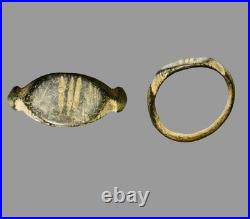
Ancient Near Eastern Bronze Amuletic “Child Protection” Ring (Circa 1st Millennium BC) US Size 2.5 Authentic. This artifact is certified authentic and will be accompanied by a Certificate of Authenticity and Provenance. All professional inventory is vetted through recognized platforms to ensure legal standing. Object: Amuletic Child / Votive Ring. Culture: Ancient Near East / Mesopotamia. Date: Circa 1000-300 BC. Form: Oval bezel featuring three deeply incised vertical strokes (linear protective motif), flanked by molded shoulders and a thin round hoop. Ring Size: US Size 2.5. Region: Mesopotamia / Levant. Iconographic Analysis: Geometric Protection Motifs. This miniature US Size 2.5 bronze ring represents ancient Near Eastern amuletic practices centered on personal and infant health. Linear Engraving: The oval bezel is incised with three vertical parallel lines or strokes. In ancient Mesopotamian and Levantine folk magic, sets of repeated lines or notches served as apotropaic tallies or protective barriers (apotropaia), meant to invoke divine favor or guard against malevolent spirits such as Lamashtu, who was believed to target infants and children. Child / Votive Scale: At a tiny US size 2.5, this ring was specifically cast for a child’s finger or worn suspended on a cord/pin as a protective charm. It may also have served as a temple votive offering dedicated by parents seeking protection for an infant. Simple Form: The streamlined oval bezel with slightly swelling shoulders reflects early bronze-casting traditions of the ancient Near East, prioritizing functional charm over elaborate display. Overview and Historical Context. Childhood mortality was a constant concern across ancient Mesopotamian and Levantine civilizations, prompting widespread use of wearable protective amulets for infants and young children. Small bronze rings like this were cast by local metalworkers as accessible, durable talismans. Used alongside spoken incantations, these daily items provided families with a tangible sense of spiritual defense. Patina: Displays a well-preserved, layered mottled dark charcoal-green and olive patina, with natural cream-colored earthen caliche deeply embedded within the three incised lines. Mineralization: Authentic copper-oxide pitting, micro-crystallization, and minor surface oxidation are present across the hoop, consistent with millennia of burial in dry soils. Construction: The delicate band exhibits minor hand-finishing asymmetries and authentic ancient wear along the inner edge. The British Museum, London: Accession No. 1917,0501.730 (Ancient Near Eastern bronze amuletic and child-sized rings). The Louvre, Paris: Department of Near Eastern Antiquities (Collection of ancient Levantine and Mesopotamian bronze charms). The Met, New York: Collection of Ancient Near Eastern small bronzes and protective amulets. The bronze is structurally sound and rigid despite its delicate size. The three incised protective strokes remain sharp and clearly visible under a natural, museum-grade patina.
Ancient Near Eastern Bronze Amuletic Child Protection Ring (1000BC) Antiquity
Roman-Bronze-Incendiary-Fire-Arrowhead-Phalarica-or-Malleolus-Type-Antiquity-01-ry

Roman Bronze Incendiary / Fire-Arrowhead (Phalarica or Malleolus Type) Antiquity

Roman Bronze Incendiary / Fire-Arrowhead (Phalarica or Malleolus Type) Antiquity

Roman Bronze Incendiary / Fire-Arrowhead (Phalarica or Malleolus Type) Antiquity
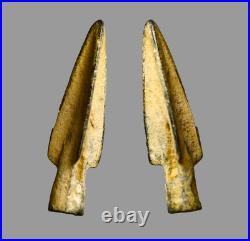
Roman Bronze Incendiary / Fire-Arrowhead (Phalarica or Malleolus Type) (Circa 1st-3rd Century AD) 35mm Authentic. This artifact is certified authentic and will be accompanied by a Certificate of Authenticity and Provenance. All professional inventory is vetted through recognized platforms to ensure legal standing. Object: Incendiary Arrowhead (Phalarica / Fire-Holding Bolt). Date: Circa 100-300 AD. Form: Trilobate / hollowed-channel projectile point designed to hold incendiary materials. Region: Imperial Roman Provinces / Frontier Finds. Typological Analysis: Ancient Incendiary Warfare. This 35mm bronze projectile is a specialized military point designed specifically for incendiary warfare. The Fire-Holding Design: Unlike conventional solid armor-piercing or barbed arrowheads, this point features deep, wide open channels along its faces. These recesses served as reservoirs to hold combustible pitch, tow, resin, or naphtha-soaked fibers without blowing out during flight. Tactical Function: Used primarily during siege operations or naval engagements, these “fire arrows” (malleoli) were fired into wooden fort structures, siege engines, or enemy sails to ignite blazes behind enemy lines. Socketed Base: Features a hollowed socket designed to take a wooden shaft, secured to withstand the violent launch forces from a composite bow or specialized torsion artillery frame. Overview and Historical Context. Incendiary weapons played a crucial role in Roman siegecraft and frontier defense. Classical authors like Ammianus Marcellinus describe the specialized construction of malleoli, noting that once ignited, the burning pitch contained within the recessed blades was extremely difficult to extinguish with water. This 35mm specimen is a remarkable survival of ancient tactical engineering, reflecting the specialized hardware used by Roman archers (sagittarii) across the garrisons of the Empire. Patina: Displays a well-preserved, layered desert-tan, sand-colored caliche, and olive-green patina, typical of long-term burial in mineral-rich soils. Mineralization: Deep-seated oxidation, heavy earthen deposits, and ancient pitting are deeply embedded within the fire-holding channels. Construction: Exhibits minor asymmetries in the blade casting and socket rim consistent with Roman field-armory production techniques. The British Museum, London: Accession No. 1883,1213.62 (Roman incendiary and trilobate military arrowheads). Römisch-Germanisches Zentralmuseum (RGZM), Mainz: Specialized holdings of Roman siege equipment and projectile points. Saalburg Roman Fort Museum, Germany: Extensive collection of military ironwork and bronze archer equipment from the Limes. Very fine archaeological condition. The bronze is structurally sound and rigid. The fire-holding channels are sharply defined, and the socket remains intact under a natural, museum-grade patina.
Roman Bronze Incendiary / Fire-Arrowhead (Phalarica or Malleolus Type) Antiquity
Ancient-Roman-Bronze-Signet-Ring-Initial-M-Marcus-Size-6-Authentic-Antiquity-COA-01-ssz

Ancient Roman Bronze Signet Ring Initial M Marcus Size 6 Authentic Antiquity COA

Ancient Roman Bronze Signet Ring Initial M Marcus Size 6 Authentic Antiquity COA

Ancient Roman Bronze Signet Ring Initial M Marcus Size 6 Authentic Antiquity COA
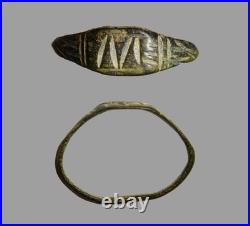
Ancient Roman Bronze Signet Ring Initial M Marcus Size 6. Authentic Ancient Artifact – Certificate of Authenticity Included. Material: Bronze Ring Size: 6 Region: Roman Empire Date: 1st-3rd Century AD Type: Personal Signet Ring. Ancient Roman bronze signet ring engraved with a bold central letter “M” framed by vertical linear borders. Single-letter signet rings were widely used across the Roman world as personal identifiers. The letter most commonly represents the owner’s praenomen, with “M” typically standing for Marcus, one of the most prevalent Roman names throughout the Republic and Empire. The elongated oval bezel and restrained geometric shoulders are characteristic of Roman utilitarian signet forms. Such rings were used to impress wax seals on documents, goods, and correspondence, functioning as both jewelry and legal signature. The simplicity of the design reflects Roman emphasis on identity and authority through initials rather than elaborate imagery. Roman citizens frequently wore engraved rings bearing their initials. Marcus was among the most common names in Roman society, used by senators, soldiers, merchants, and administrators alike. This ring represents the tangible personal identity of a Roman individual nearly two millennia ago. Surface patina consistent with age. Wear patterns consistent with prolonged ancient use. Engraving depth natural and not mechanically cut. No visible modern casting seams. Minor surface wear consistent with antiquity.
Ancient Roman Bronze Signet Ring Initial M Marcus Size 6 Authentic Antiquity COA
Phoenician-Bronze-Horse-Mount-Color-Inlay-Hellenistic-Period-300-100BC-Antiquity-01-wgvr

Phoenician Bronze Horse Mount Color Inlay Hellenistic Period 300-100BC Antiquity

Phoenician Bronze Horse Mount Color Inlay Hellenistic Period 300-100BC Antiquity

Phoenician Bronze Horse Mount Color Inlay Hellenistic Period 300-100BC Antiquity
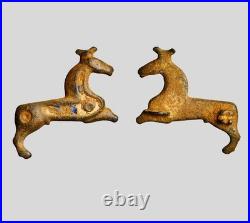
Phoenician Bronze Horse Mount with Inlay, Hellenistic Period 300-100BC. Authentic Ancient Artifact – Guaranteed This object is a genuine Phoenician-period bronze horse mount or applique dating to the Hellenistic era, circa 3rd-1st century BC. The piece displays surviving inlaid decoration and reflects Levantine craftsmanship under strong Greek cultural influence. Details Material: Bronze with mineral inlay traces Date: circa 300-100BC Culture: Phoenician / Hellenistic Greek sphere Form: Horse-shaped mount or applique Manufacture: Cast with applied inlay Length: 40 mm Condition: Complete with ancient wear and stable patina. Overview This finely cast bronze mount depicts a stylized horse in motion, rendered in a distinctly Phoenician manner while incorporating Hellenistic naturalism in posture and proportion. The elongated body, raised head, and arched neck reflect the symbolic importance of the horse in Phoenician and broader Mediterranean culture, where it represented status, mobility, and martial prestige. Traces of colored inlay remain visible on the body, a notable feature associated with Phoenician metalwork, which frequently employed inlaid materials to enhance visual impact. Such horse figures were used as decorative mounts on harness equipment, belts, chariots, or ceremonial objects. During the Hellenistic period, Phoenician artisans continued local traditions while adapting Greek stylistic elements, resulting in hybrid objects such as this example. Authenticity Check The mount is cast in bronze using period-consistent techniques and exhibits a cohesive ancient patina with areas of mineral accretion. The inlay remnants are consistent with ancient decorative practices and show natural degradation rather than modern application. Surface wear, corrosion texture, and casting details align with authentic Phoenician and Hellenistic metalwork. No modern repairs or alterations are observed. Comparable Examples Comparable Phoenician bronze horse mounts and appliques with inlay are documented from Levantine coastal sites and Hellenistic-period contexts. Similar examples appear in museum collections and archaeological publications relating to Phoenician decorative metal objects and equestrian symbolism. Further Reading Markoe, G. Greek Art in the Hellenistic Period. The Phoenicians and the West. Complete as recovered, with expected surface wear, partial inlay loss, and stable patina consistent with age and use. Structurally sound, with no modern restoration.
Phoenician Bronze Horse Mount Color Inlay Hellenistic Period 300-100BC Antiquity
Antiquity-Authentic-Viking-Norse-Solid-Silver-Belt-Fitting-Strap-Slide-900AD-01-dq

Antiquity Authentic Viking Norse Solid Silver Belt Fitting / Strap Slide 900AD

Antiquity Authentic Viking Norse Solid Silver Belt Fitting / Strap Slide 900AD

Antiquity Authentic Viking Norse Solid Silver Belt Fitting / Strap Slide 900AD
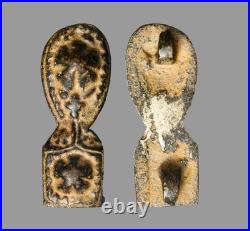
Premium Viking Age Solid Silver Belt Fitting / Strap Slide (Circa 9th-10th Century AD) 28mm Authentic. Authenticity Notice This artifact is certified authentic and will be accompanied by a Certificate of Authenticity and Provenance. Object: Zoomorphic Belt Fitting / Strap Slide. Culture: Viking / Norse (Found in Germany/Northern Saxony). Date: Circa 9th-10th Century AD. Material: Solid Silver (High-purity bullion). Form: Hourglass-shaped terminal with relief ornamentation and dual-lug reverse. Region: North Germany / Baltic Trade Route. Identification: Viking Zoomorphic Strap Fitting The 28mm silver artifact 15_3. Jpg is a high-status Viking Age Strap Slide, used to secure the loose end of a leather belt or horse harness. The Iconography: The obverse features deeply cast relief patterns typical of the Borre or Jelling styles. The top circular section depicts a stylized zoomorphic mask or “gripping beast, ” while the square base contains a quatrefoil or cruciform knotwork design. The Material: In the Viking world, solid silver was the ultimate marker of “Hacksilver” wealth. Artifacts like this were often used as currency in trade when weight-equivalent silver was required. The Reverse: The reverse features two robust, integral attachment lugs. These would have been passed through a thick leather strap and hammered over (clenched) to provide a permanent, secure mounting. Overview and Historical Context Found and registered in Germany, this relic originates from the intense contact zone between the Viking North and the Ottonian/Saxon South. These fittings were essential components of the elaborate warrior’s belt. For a Viking raider or trader, a silver-mounted belt was not merely functional; it was a visible bank account and a display of martial success. The dark, niello-like “horn” patina currently covering the silver is a result of centuries of contact with organic matter in the soil, preserving the high-relief details of the Norse knotwork. The artifact displays a superb, thick archaeological patina with localized “horn silver” (silver chloride) oxidation and earthen mineralization. The relief carving shows characteristic “V-shaped” troughs and softening consistent with ancient lost-wax casting. The reverse lugs exhibit genuine asymmetrical wear and crystalline structural fatigue at the stress points. No evidence of modern centrifugal casting, mechanical filing, or artificial chemical staining. State Museum of Lower Saxony, Hannover : Significant holdings of Viking-Saxon transition silver metalwork. The British Museum, London : Accession No. 1853,1214.34 (Viking silver strap-ends and fittings). National Museum of Denmark, Copenhagen : Extensive collection of Borre-style zoomorphic belt mounts. Graham-Campbell, James – Viking Art : For the classification of zoomorphic motifs on silver fittings. Kershaw, Jane – Viking Identities : Regarding the distribution of Norse metalwork in the Germanic regions. Condition Superior archaeological condition. The silver remains exceptionally dense and structurally sound. The complex Norse iconography is prominently preserved under a museum-grade patina.

Antiquity Authentic Viking Norse Solid Silver Belt Fitting / Strap Slide 900AD
Ancient-Norse-Viking-Early-Medieval-Silver-Signet-Ring-Artifact-Antiquity-wCOA-01-phwf

Ancient Norse Viking / Early Medieval Silver Signet Ring Artifact Antiquity wCOA

Ancient Norse Viking / Early Medieval Silver Signet Ring Artifact Antiquity wCOA

Ancient Norse Viking / Early Medieval Silver Signet Ring Artifact Antiquity wCOA
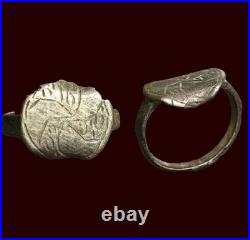
Ancient Norse Viking / Early Medieval Silver Signet Ring with Engraved Symbol – Circa 9th-11th Century AD – Germanic Find / US Size 3 Guaranteed genuine authentic ancient artifact with a Certificate of Authenticity. Culture: Norse / Viking (Early Medieval Germanic) Date: Circa 9th-11th Century AD Material: Solid Silver (High-Grade Alloy) Type: Personal Signet Ring / Totemic Symbol Ring Design: Broad, Flattened Oval Bezel Deeply Incised with an Interlocking Geometric/Zoomorphic Symbol Size: US Ring Size 3. Description An exceptional, museum-grade ancient Viking silver signet ring dating from the height of the Norse expansion, circa 9th to 11th Century AD, recovered from a Germanic regional find context. This highly important personal ornament features an expansive, hammered oval bezel that seamlessly integrates into a sturdy, tapering hoop. As visible in the provided image 7. Jpg, the primary face of the bezel is hand-engraved with an intriguing, deeply incised symbol composed of interlocking linear strokes and stylized fronds-forming a dynamic geometric or proto-heraldic zoomorphic motif characteristic of early northern European tribal markers. The solid silver has stabilized beautifully over the centuries, displaying a magnificent, authentic horn-silver coloration with deep charcoal-toned tarnish in the recessed areas. The hand-cut grooves of the symbol and the sheltered inner contours of the hoop retain clear traces of an untouched, rock-hard dark mineralized burial matrix, providing superb visual definition and striking contrast against the bright, reflective metallic surfaces. Historical & Epigraphic Context During the Viking Age, silver was the primary currency and status indicator across the Norse and Germanic worlds. While silver arm rings and ingots were frequently hacked apart for bullion trade (hack-silver), finely crafted personal signet rings were prized possessions belonging to elite merchants, warriors, or regional chieftains. These rings served as symbols of swearing oaths, indicators of social status, and functional stamp devices to mark property or trade goods. The distinctive abstract carving on this specimen reflects the traditional artistic transition away from complex Carolingian forms toward bold, linear, geometric expressions of family, tribal, or cultic allegiance popular in the Baltic and Germanic trade zones. Exact typological parallels for Early Medieval and Norse silver signet rings of this form, material composition, and period are preserved in major global institutions. Specific comparative specimens include. The British Museum, London: Department of Britain, Europe and Prehistory / Viking Age Collection cf. Museum Number BM 1915,1208.2 / Silver finger ring with stamped and incised decoration. The National Museum of Denmark (Nationalmuseet), Copenhagen: Danish Prehistory and Viking Treasures Corpus cf. NM-V-3819 for silver signet rings from regional hoards. The State Archaeological Museum (Archäologisches Landesmuseum), Schleswig: Gottorf Castle Viking Age Registry cf. ALM-1988,241 for personal silver ornaments recovered from Hedeby and North Germanic contexts. This remarkably preserved artifact represents an incredibly rare, intimate, and tactile link to the personal identity, seafaring trade networks, and metalworking mastery of the Viking world. Condition & Authenticity Condition: Excellent archaeological condition. The high-grade silver structure is entirely solid, stable, and completely intact, featuring a strong, unbroken hoop. The hand-engraved symbol on the bezel remains crisp, deep, and fully legible without any modern paring or aggressive cleaning. The ring exhibits perfect diagnostic signatures of ancient Norse smithing, including manual hammering, edge shaping, and hand-chiseled engraving. The deep silver-sulfide tarnish and fused micro-matrix are entirely consistent with over a thousand years of interment.
Ancient Norse Viking / Early Medieval Silver Signet Ring Artifact Antiquity wCOA
Christian-Cross-Antiquity-Ancient-Eastern-Roman-Byzantine-Soldier-s-Buckle-01-adzf

Christian Cross Antiquity Ancient Eastern Roman / Byzantine Soldier’s Buckle

Christian Cross Antiquity Ancient Eastern Roman / Byzantine Soldier's Buckle

Christian Cross Antiquity Ancient Eastern Roman / Byzantine Soldier's Buckle
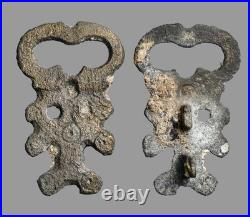
Eastern Roman / Byzantine Bronze Soldier’s Buckle (Circa 5th-7th Century AD) 45mm Authentic. Authenticity Notice This artifact is certified authentic and will be accompanied by a Certificate of Authenticity and Provenance. Object: Military Belt Buckle / Plate. Culture: Eastern Roman (Byzantine). Date: Circa 5th-7th Century AD. Form: Openwork loop integrated with a stylized plate featuring geometric “Eye” motifs. Region: Eastern Mediterranean / Byzantine Empire. Identification: Military Plate with “Magic Eye” Protection This 45mm bronze buckle represents a significant piece of military equipment from the early Byzantine period. The Design : The buckle features a broad loop and a decorative plate characterized by distinctive “Magic Eye” (Ring-and-Dot) motifs. These were common apotropaic symbols intended to ward off the “Evil Eye” and protect the wearer in battle. The Reverse : The back retains its original, robust attachment lugs used to secure the buckle to a thick leather military belt. Surface Detail : The obverse displays deep punch-work forming these protective “eyes, ” a decorative technique frequent in the 6th and 7th centuries across the Empire’s frontier provinces. Overview and Historical Context In the Eastern Roman Empire, the military belt was a primary symbol of status and state authority. This 45mm buckle belonged to a professional soldier and combines functional durability with the folk-magic symbols of the era. The use of “magic eyes” on military gear illustrates the personal superstitions and protective charms relied upon by soldiers stationed in high-conflict border regions. Patina : The artifact displays a superb, stable “Silver-Grey” to “Olive” patina, with localized patches of earthen mineralization and coppery highlights. Mineralization : There is deep-seated crystallization and characteristic “pitting” within the bronze, consistent with over 1,400 years of burial. Construction : The lugs on the reverse show genuine structural fatigue and manual finishing marks, distinguishing it from modern pressure-cast reproductions. The British Museum, London : Accession No. 1923,0512.446 (Byzantine bronze buckles with geometric punch-work). Dumbarton Oaks, Washington D. Significant collection of Early Byzantine military metalwork featuring ring-and-dot ornamentation. Metropolitan Museum of Art, New York : Accession No. 17.190.1666 (Eastern Roman bronze buckle types with apotropaic symbols). Schulze-Dörrlamm, Maria – Byzantinische Gürtelschnallen : The definitive typology for Byzantine belt buckles. Maguire, Henry – Byzantine Magic : For context on the use of “magic eyes” and protective symbols on daily objects. Condition Excellent archaeological condition. The bronze is dense and stable. The original mounting lugs remain intact, and the protective geometric motifs are clearly defined under a museum-grade patina.
Christian Cross Antiquity Ancient Eastern Roman / Byzantine Soldier's Buckle
Egyptian-Antiquities-UNIQUE-ANTIQUITY-PHARAONIC-MASK-Of-Pharaoh-Tutankhamun-BC-01-goe

Egyptian Antiquities UNIQUE ANTIQUITY PHARAONIC MASK Of Pharaoh Tutankhamun BC

Egyptian Antiquities UNIQUE ANTIQUITY PHARAONIC MASK Of Pharaoh Tutankhamun BC

Egyptian Antiquities UNIQUE ANTIQUITY PHARAONIC MASK Of Pharaoh Tutankhamun BC
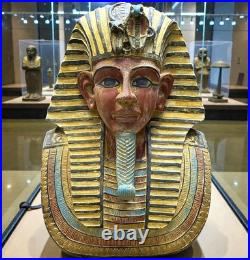
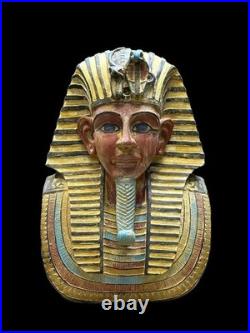
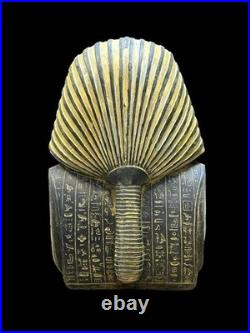
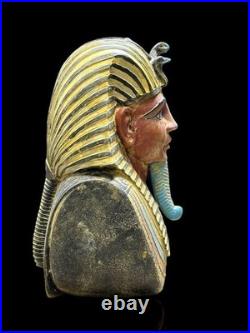
Egyptian Antiquities UNIQUE ANTIQUITY PHARAONIC MASK Of Pharaoh Tutankhamun BC. This vintage reproduction It is a rare piece of Egyptian antiquity made in Egypt. Now own this rare Pharaonic piece, feel the ancient Pharaonic history and civilization, and decorate your home and office with it. This is an incredible antique mask of Pharaoh Tutankhamun, crafted with great skill and attention to detail. The statue is made of high-quality stone and features a striking multi-color design that brings the portrait of the great pharaoh to life. The statue is a vintage reproduction, but its style and features are truly antique, making it a perfect addition to any collection of decorative collectibles. The statue’s age is unknown, but it is clear that it has stood the test of time and will continue to be a cherished possession for years to come. A Simplified Historical Overview Of Tutankhamun. Tutankhamun is one of the pharaohs of the eighteenth Egyptian family in the history of ancient Egypt, and he was the pharaoh of Egypt from 1334 BC to 1325 BC. Tutankhamun died young and was buried in his tomb in the Valley of the Kings. Tutankhamun was nine years old when he became Pharaoh of Egypt, and his name in the ancient Egyptian language means “the living image of the god Amun”, the chief of the ancient Egyptian gods. Tutankhamun lived in a transitional period in the history of ancient Egypt, where he came after Akhenaten , who tried to unite the gods of ancient Egypt in the form of the One God. During his reign, a return to the worship of the multiple gods of ancient Egypt took place. His tomb was discovered in 1922 in the Valley of the Kings by British archaeologist Howard Carter. This discovery caused a widespread media stir in the world. As Shown In Pictures. That the Item Will Delivered to You As Shown in Pictures Therefore we recommend that you see the picture well and then take your decision and take your responsibility. I check myself each product and sell only the best quality products. In any case, if you are not satisfied with the product, first, please contact me and I will do everything to your. We Welcome Any Inquiries at Any Time We Respond to Messages in Less Than 24 Hours. We Are Always Serving Our Customers. Perfect Condition as shown in pictures. 100 % Egypt Luxor Hand Carved stone. (Offer provided by the store).
Egyptian Antiquities UNIQUE ANTIQUITY PHARAONIC MASK Of Pharaoh Tutankhamun BC
Artifact-Authentic-Antiquity-Crusader-Christian-Strap-Fitting-Angel-Wings-01-axry

Artifact Authentic Antiquity Crusader Christian Strap Fitting Angel Wings

Artifact Authentic Antiquity Crusader Christian Strap Fitting Angel Wings

Artifact Authentic Antiquity Crusader Christian Strap Fitting Angel Wings
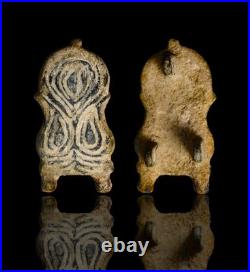
Crusader Christian Strap Fitting with Stylized Angel Wings Latin East, c. As with all items offered by Georgian Bay Antiquities, this artifact is guaranteed authentic and is accompanied by a Certificate of Authenticity detailing material, typology, dating, and cultural attribution. Object: Strap fitting / buckle plate Material: Bronze (copper alloy) Date: Crusader period, c. 50 mm Form: Cast plate with rear attachment lugs. This Crusader-period bronze strap fitting displays a strongly symbolic Christian design interpreted as stylized angel wings, rendered in a bold, linear manner characteristic of Crusader metalwork from the Latin East. The front surface is decorated with symmetrical, flowing motifs forming paired wing-like shapes, evoking celestial protection and divine guardianship. Such imagery aligns closely with medieval Christian representations of angels as protectors of the faithful and defenders in spiritual and physical warfare. In the Crusader context, angelic symbolism carried particular weight. Angels were understood as heavenly warriors and messengers of God, closely associated with divine protection in battle and pilgrimage. Strap fittings and buckles bearing overt Christian symbolism were worn on belts, harnesses, armor fittings, or devotional garments, serving both practical and apotropaic purposes. The abstracted style reflects a regional synthesis of Western Christian iconography with local Eastern artistic traditions. The reverse retains multiple cast attachment lugs, indicating that the object was firmly mounted to leather or textile. This construction confirms its use as a functional fitting rather than a purely decorative plaque. The robust casting and clear iconographic intent suggest ownership by an individual closely connected to the Crusader military or devotional environment, such as a knight, pilgrim, or clerical retainer. The object exhibits correct Crusader-period bronze composition and casting technique. Surface wear, mineral accretions, and patination are consistent with long-term burial and use. No evidence of modern tooling, artificial aging, or restoration is observed. Comparable Crusader strap fittings and devotional metalwork with angelic or winged symbolism are preserved in institutional collections, including examples from the Latin East held by the British Museum, the Louvre Museum, the Israel Museum, and the Metropolitan Museum of Art, where similar fittings are catalogued as Crusader harness or belt components with Christian iconography. References include Denys Pringle, The Churches of the Crusader Kingdom of Jerusalem, Jaroslav Folda, The Art of the Crusaders in the Holy Land, and British Museum Collection Online, Crusader metal fittings. Condition: Very good archaeological condition. Complete form with attachment lugs intact. Surface wear consistent with age and use.
Artifact Authentic Antiquity Crusader Christian Strap Fitting Angel Wings
Rare-Egyptian-Antiquities-Of-Antiquity-Pharaonic-Statue-Of-Egyptian-King-Khafre-01-dwha

Rare Egyptian Antiquities Of Antiquity Pharaonic Statue Of Egyptian King Khafre

Rare Egyptian Antiquities Of Antiquity Pharaonic Statue Of Egyptian King Khafre

Rare Egyptian Antiquities Of Antiquity Pharaonic Statue Of Egyptian King Khafre
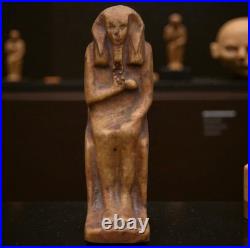
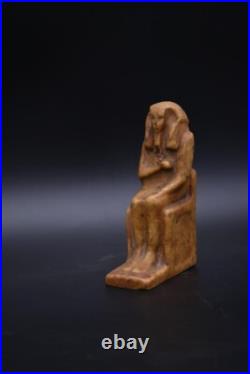
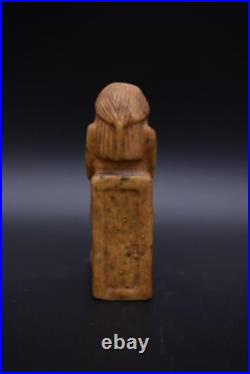
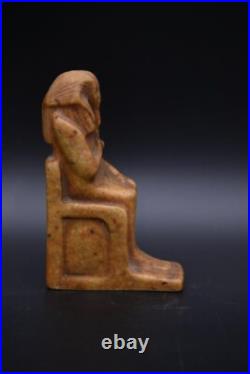
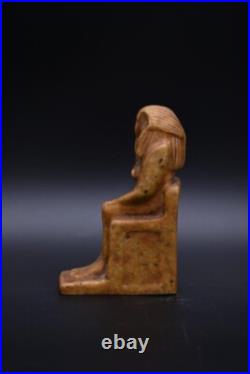
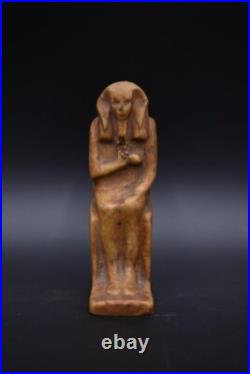
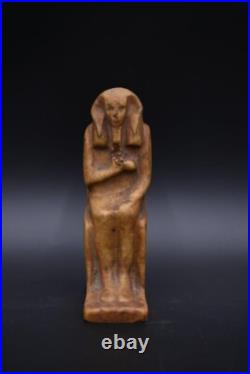
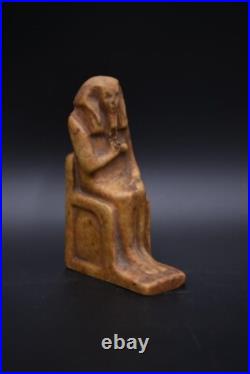
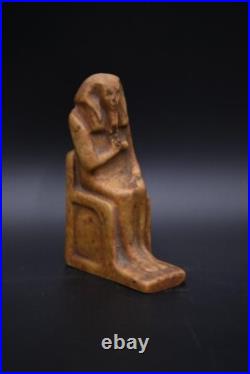
Rare Egyptian Antiquities Of Antiquity Pharaonic Statue Of Egyptian King Khafre. This vintage reproduction It is a rare piece of Egyptian antiquity made in Egypt. Now own this rare Pharaonic piece, feel the ancient Pharaonic history and civilization, and decorate your home and office with it. This unique antique statue features the ancient Egyptian kings Khafre, represented in stunning detail and vibrant color. Crafted from high-quality stone and featuring intricate decorative elements, this piece is a true masterpiece. The statue is a vintage reproduction, perfect for collectors and enthusiasts of antique decor. Its age and origin are unknown, adding to its mysterious and alluring appeal. Add this one-of-a-kind piece to your collection today and enjoy its beauty and intrigue for years to come. A Simplified Historical Overview Of Khafre And Horus. Khafre or Khafra (Ancient Egyptian: He appears as Ra), also known as Khephren or Chephren, was an ancient Egyptian pharaoh of the Fourth Dynasty during the Old Kingdom. He was the son of Khufu and the successor of Djedefre. According to the ancient historian Manetho, Khafre was followed by king Bikheris, but according to archaeological evidence he was instead followed by king Menkaure. Khafre was the builder who made the second largest pyramid at Giza. The view held by modern Egyptology at large continues to be that the Great Sphinx of Giza was built in approximately 2500 BC for Khafre. Not much is known about Khafre, except from the reports of Herodotus, writing 2,000 years after his life. As Shown In Pictures. That the Item Will Delivered to You As Shown in Pictures Therefore we recommend that you see the picture well and then take your decision and take your responsibility. I check myself each product and sell only the best quality products. In any case, if you are not satisfied with the product, first, please contact me and I will do everything to your. We Welcome Any Inquiries at Any Time We Respond to Messages in Less Than 24 Hours. We Are Always Serving Our Customers. Perfect Condition as shown in pictures. 100 % Egypt Luxor Hand Carved Stone. (Offer provided by the store).


Rare Egyptian Antiquities Of Antiquity Pharaonic Statue Of Egyptian King Khafre