
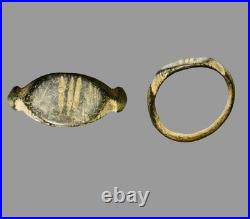




Ancient Near Eastern Bronze Amuletic “Child Protection” Ring (Circa 1st Millennium BC) US Size 2.5 Authentic. This artifact is certified authentic and will be accompanied by a Certificate of Authenticity and Provenance. All professional inventory is vetted through recognized platforms to ensure legal standing. Object: Amuletic Child / Votive Ring. Culture: Ancient Near East / Mesopotamia. Date: Circa 1000-300 BC. Form: Oval bezel featuring three deeply incised vertical strokes (linear protective motif), flanked by molded shoulders and a thin round hoop. Ring Size: US Size 2.5. Region: Mesopotamia / Levant. Iconographic Analysis: Geometric Protection Motifs. This miniature US Size 2.5 bronze ring represents ancient Near Eastern amuletic practices centered on personal and infant health. Linear Engraving: The oval bezel is incised with three vertical parallel lines or strokes. In ancient Mesopotamian and Levantine folk magic, sets of repeated lines or notches served as apotropaic tallies or protective barriers (apotropaia), meant to invoke divine favor or guard against malevolent spirits such as Lamashtu, who was believed to target infants and children. Child / Votive Scale: At a tiny US size 2.5, this ring was specifically cast for a child’s finger or worn suspended on a cord/pin as a protective charm. It may also have served as a temple votive offering dedicated by parents seeking protection for an infant. Simple Form: The streamlined oval bezel with slightly swelling shoulders reflects early bronze-casting traditions of the ancient Near East, prioritizing functional charm over elaborate display. Overview and Historical Context. Childhood mortality was a constant concern across ancient Mesopotamian and Levantine civilizations, prompting widespread use of wearable protective amulets for infants and young children. Small bronze rings like this were cast by local metalworkers as accessible, durable talismans. Used alongside spoken incantations, these daily items provided families with a tangible sense of spiritual defense. Patina: Displays a well-preserved, layered mottled dark charcoal-green and olive patina, with natural cream-colored earthen caliche deeply embedded within the three incised lines. Mineralization: Authentic copper-oxide pitting, micro-crystallization, and minor surface oxidation are present across the hoop, consistent with millennia of burial in dry soils. Construction: The delicate band exhibits minor hand-finishing asymmetries and authentic ancient wear along the inner edge. The British Museum, London: Accession No. 1917,0501.730 (Ancient Near Eastern bronze amuletic and child-sized rings). The Louvre, Paris: Department of Near Eastern Antiquities (Collection of ancient Levantine and Mesopotamian bronze charms). The Met, New York: Collection of Ancient Near Eastern small bronzes and protective amulets. The bronze is structurally sound and rigid despite its delicate size. The three incised protective strokes remain sharp and clearly visible under a natural, museum-grade patina.