


Category Archives: roman

Roman-Old-King-Lion-attack-Jasper-Stone-Hunting-Scene-Intaglio-Seal-Bead-01-sxm

Roman Old King & Lion attack Jasper Stone Hunting Scene Intaglio Seal Bead

Roman Old King & Lion attack Jasper Stone Hunting Scene Intaglio Seal Bead

Roman Old King & Lion attack Jasper Stone Hunting Scene Intaglio Seal Bead
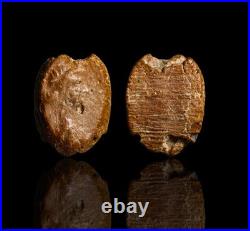
This is a unique and exquisite Roman old king and lion attack jasper stone hunting scene Intaglio seal bead. The bead is made of stone material and was manufactured in the pre-1400 time period. Its origin can be traced back to the Roman era, making it a rare collectible item for those interested in ancient artifacts. The bead features a beautifully carved hunting scene, where an old king is seen attacking a lion with a spear. The intricate details on the bead are a testament to the craftsmanship of the ancient Romans, and it is a perfect addition to any collection of pre-1400 collectibles or beads. The bead falls under the category of collectibles, specifically beads, and is a must-have for anyone interested in ancient history.
Roman Old King & Lion attack Jasper Stone Hunting Scene Intaglio Seal Bead
Roman-Bronze-Incendiary-Fire-Arrowhead-Phalarica-or-Malleolus-Type-Antiquity-01-ry

Roman Bronze Incendiary / Fire-Arrowhead (Phalarica or Malleolus Type) Antiquity

Roman Bronze Incendiary / Fire-Arrowhead (Phalarica or Malleolus Type) Antiquity

Roman Bronze Incendiary / Fire-Arrowhead (Phalarica or Malleolus Type) Antiquity
Roman Bronze Incendiary / Fire-Arrowhead (Phalarica or Malleolus Type) (Circa 1st-3rd Century AD) 35mm Authentic. This artifact is certified authentic and will be accompanied by a Certificate of Authenticity and Provenance. All professional inventory is vetted through recognized platforms to ensure legal standing. Object: Incendiary Arrowhead (Phalarica / Fire-Holding Bolt). Date: Circa 100-300 AD. Form: Trilobate / hollowed-channel projectile point designed to hold incendiary materials. Region: Imperial Roman Provinces / Frontier Finds. Typological Analysis: Ancient Incendiary Warfare. This 35mm bronze projectile is a specialized military point designed specifically for incendiary warfare. The Fire-Holding Design: Unlike conventional solid armor-piercing or barbed arrowheads, this point features deep, wide open channels along its faces. These recesses served as reservoirs to hold combustible pitch, tow, resin, or naphtha-soaked fibers without blowing out during flight. Tactical Function: Used primarily during siege operations or naval engagements, these “fire arrows” (malleoli) were fired into wooden fort structures, siege engines, or enemy sails to ignite blazes behind enemy lines. Socketed Base: Features a hollowed socket designed to take a wooden shaft, secured to withstand the violent launch forces from a composite bow or specialized torsion artillery frame. Overview and Historical Context. Incendiary weapons played a crucial role in Roman siegecraft and frontier defense. Classical authors like Ammianus Marcellinus describe the specialized construction of malleoli, noting that once ignited, the burning pitch contained within the recessed blades was extremely difficult to extinguish with water. This 35mm specimen is a remarkable survival of ancient tactical engineering, reflecting the specialized hardware used by Roman archers (sagittarii) across the garrisons of the Empire. Patina: Displays a well-preserved, layered desert-tan, sand-colored caliche, and olive-green patina, typical of long-term burial in mineral-rich soils. Mineralization: Deep-seated oxidation, heavy earthen deposits, and ancient pitting are deeply embedded within the fire-holding channels. Construction: Exhibits minor asymmetries in the blade casting and socket rim consistent with Roman field-armory production techniques. The British Museum, London: Accession No. 1883,1213.62 (Roman incendiary and trilobate military arrowheads). Römisch-Germanisches Zentralmuseum (RGZM), Mainz: Specialized holdings of Roman siege equipment and projectile points. Saalburg Roman Fort Museum, Germany: Extensive collection of military ironwork and bronze archer equipment from the Limes. Very fine archaeological condition. The bronze is structurally sound and rigid. The fire-holding channels are sharply defined, and the socket remains intact under a natural, museum-grade patina.
Roman Bronze Incendiary / Fire-Arrowhead (Phalarica or Malleolus Type) Antiquity
Roman-Terracotta-Portrait-Bust-Septimius-Severus-200AD-Roman-Antiquities-COA-01-ihqr

Roman Terracotta Portrait Bust Septimius Severus 200AD Roman Antiquities COA

Roman Terracotta Portrait Bust Septimius Severus 200AD Roman Antiquities COA

Roman Terracotta Portrait Bust Septimius Severus 200AD Roman Antiquities COA
Roman Terracotta Portrait Bust Septimius Severus 200AD. Item Object: Miniature terracotta portrait head / bust fragment Culture: Roman Imperial Date: c. 193-211AD (reign of Septimius Severus) Material: Terracotta (fired clay) Type: Small-scale portrait appliqué / figurine fragment Size: Approx. 15 mm Provenance: Eastern Roman Empire, Near Eastern production (old collection). Description This miniature terracotta portrait fragment represents a Roman imperial male, consistent in scale, fabric, and facial treatment with small provincial terracotta portraits of the Severan period. Despite surface wear, the heavy jawline, broad facial proportions, and surviving beard texture align closely with known portrait conventions of Septimius Severus, founder of the Severan dynasty. Such small terracotta portraits were produced widely in the eastern provinces and served domestic, devotional, or commemorative functions. Unlike large marble or bronze imperial portraits, these clay examples were affordable objects intended for private households, shrines, or local civic spaces. The flattened reverse and compact scale suggest it was either mounted or set into a niche rather than free-standing. Septimius Severus was particularly prominent in eastern provinces, and his image circulated extensively in Egypt, Syria, and Judaea, making terracotta portrait fragments of his likeness well-attested archaeologically. The firing, clay composition, and surface abrasion are consistent with Roman imperial terracotta production rather than later medieval or modern manufacture. Museum Parallels Comparable Roman terracotta imperial portraits can be found in. British Museum, London – Roman terracotta heads and portrait fragments, Inv. 1907,0213.12; 1912,0615.3. Louvre Museum, Paris – Roman provincial terracotta portraits, Département des Antiquités grecques, étrusques et romaines, Inv. CA 1324, CA 1789. Ashmolean Museum, Oxford – Roman terracotta figurines and portrait heads, Inv. AN1923.45; AN1968.311. Roman Sculpture, Yale University Press, pp. 315-323 (Severan portrait typology). Smith, R. R. R. Roman Portrait Statuary from Aphrodisias, esp. Terres cuites de l’Égypte romaine, sections on imperial portrait fragments. Condition Fragmentary but intact. Facial mass preserved with visible beard texture and worn surface detail. Expected chips and abrasion from burial and age. Authenticity Guaranteed authentic Roman Imperial terracotta artifact, circa Severan period. Comes with lifetime authenticity guarantee from Affordable Ancients.
Roman Terracotta Portrait Bust Septimius Severus 200AD Roman Antiquities COA
Lot-of-100-Roman-Bronze-Coins-Unique-Collection-for-Enthusiasts-01-jnhd

Lot of 100 Roman Bronze Coins Unique Collection for Enthusiasts

Lot of 100 Roman Bronze Coins Unique Collection for Enthusiasts

Lot of 100 Roman Bronze Coins Unique Collection for Enthusiasts
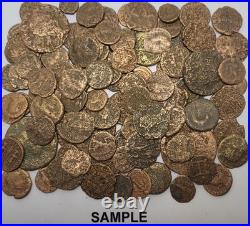
Lot of 100 Roman Bronze Coins – Unique Collection for Enthusiasts! Explore Late Roman low-grade bronze coins from AD 250 to 430, each featuring a portrait profile. Add these coins to your collection or gift them to someone starting their coin collection. Please take a look at my other listings. Small sets of coins. China, People’s Republic. Germany, Democratic Republic (DDR). United States of America. Medium sets of coins. Bulk sets of coins.
Lot of 100 Roman Bronze Coins Unique Collection for Enthusiasts
Roman-AE-Coin-of-Diocletian-AD-284-305-NGC-F-Collectible-Treasure-01-ix

Roman AE Coin of Diocletian (AD 284-305) NGC(F) Collectible Treasure

Roman AE Coin of Diocletian (AD 284-305) NGC(F) Collectible Treasure

Roman AE Coin of Diocletian (AD 284-305) NGC(F) Collectible Treasure
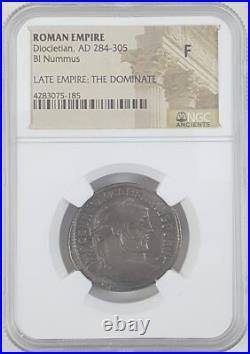
Roman AE Coin of Diocletian (AD 284-305) NGC(F) – Collectible Treasure! In 284, Diocletian took charge, bringing an end to a chaotic era of rule. He was notorious for his harsh stance against Christians and is famously known for his Palace, an inspiration for 19th-century Adam-style homes. Size: 19.8-27.5 mm. Obverse: Features the Emperor’s portrait. Reverse: Displays various mythological and military scenes. Add these coins to your collection or gift them to someone starting their coin collection. Please take a look at my other listings. 50 Different World coins. 100 Different World coins. 150 Coins from 30 countries. 1500 Coins from 160 Countries. Small sets of coins. China, People’s Republic. Germany, Democratic Republic (DDR). United States of America. Medium sets of coins. Bulk sets of coins.
Roman AE Coin of Diocletian (AD 284-305) NGC(F) Collectible Treasure