
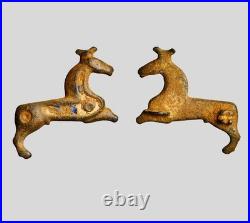




Phoenician Bronze Horse Mount with Inlay, Hellenistic Period 300-100BC. Authentic Ancient Artifact – Guaranteed This object is a genuine Phoenician-period bronze horse mount or applique dating to the Hellenistic era, circa 3rd-1st century BC. The piece displays surviving inlaid decoration and reflects Levantine craftsmanship under strong Greek cultural influence. Details Material: Bronze with mineral inlay traces Date: circa 300-100BC Culture: Phoenician / Hellenistic Greek sphere Form: Horse-shaped mount or applique Manufacture: Cast with applied inlay Length: 40 mm Condition: Complete with ancient wear and stable patina. Overview This finely cast bronze mount depicts a stylized horse in motion, rendered in a distinctly Phoenician manner while incorporating Hellenistic naturalism in posture and proportion. The elongated body, raised head, and arched neck reflect the symbolic importance of the horse in Phoenician and broader Mediterranean culture, where it represented status, mobility, and martial prestige. Traces of colored inlay remain visible on the body, a notable feature associated with Phoenician metalwork, which frequently employed inlaid materials to enhance visual impact. Such horse figures were used as decorative mounts on harness equipment, belts, chariots, or ceremonial objects. During the Hellenistic period, Phoenician artisans continued local traditions while adapting Greek stylistic elements, resulting in hybrid objects such as this example. Authenticity Check The mount is cast in bronze using period-consistent techniques and exhibits a cohesive ancient patina with areas of mineral accretion. The inlay remnants are consistent with ancient decorative practices and show natural degradation rather than modern application. Surface wear, corrosion texture, and casting details align with authentic Phoenician and Hellenistic metalwork. No modern repairs or alterations are observed. Comparable Examples Comparable Phoenician bronze horse mounts and appliques with inlay are documented from Levantine coastal sites and Hellenistic-period contexts. Similar examples appear in museum collections and archaeological publications relating to Phoenician decorative metal objects and equestrian symbolism. Further Reading Markoe, G. Greek Art in the Hellenistic Period. The Phoenicians and the West. Complete as recovered, with expected surface wear, partial inlay loss, and stable patina consistent with age and use. Structurally sound, with no modern restoration.