
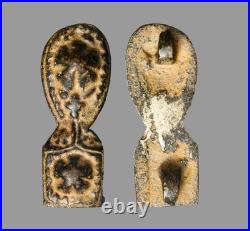


Premium Viking Age Solid Silver Belt Fitting / Strap Slide (Circa 9th-10th Century AD) 28mm Authentic. Authenticity Notice This artifact is certified authentic and will be accompanied by a Certificate of Authenticity and Provenance. Object: Zoomorphic Belt Fitting / Strap Slide. Culture: Viking / Norse (Found in Germany/Northern Saxony). Date: Circa 9th-10th Century AD. Material: Solid Silver (High-purity bullion). Form: Hourglass-shaped terminal with relief ornamentation and dual-lug reverse. Region: North Germany / Baltic Trade Route. Identification: Viking Zoomorphic Strap Fitting The 28mm silver artifact 15_3. Jpg is a high-status Viking Age Strap Slide, used to secure the loose end of a leather belt or horse harness. The Iconography: The obverse features deeply cast relief patterns typical of the Borre or Jelling styles. The top circular section depicts a stylized zoomorphic mask or “gripping beast, ” while the square base contains a quatrefoil or cruciform knotwork design. The Material: In the Viking world, solid silver was the ultimate marker of “Hacksilver” wealth. Artifacts like this were often used as currency in trade when weight-equivalent silver was required. The Reverse: The reverse features two robust, integral attachment lugs. These would have been passed through a thick leather strap and hammered over (clenched) to provide a permanent, secure mounting. Overview and Historical Context Found and registered in Germany, this relic originates from the intense contact zone between the Viking North and the Ottonian/Saxon South. These fittings were essential components of the elaborate warrior’s belt. For a Viking raider or trader, a silver-mounted belt was not merely functional; it was a visible bank account and a display of martial success. The dark, niello-like “horn” patina currently covering the silver is a result of centuries of contact with organic matter in the soil, preserving the high-relief details of the Norse knotwork. The artifact displays a superb, thick archaeological patina with localized “horn silver” (silver chloride) oxidation and earthen mineralization. The relief carving shows characteristic “V-shaped” troughs and softening consistent with ancient lost-wax casting. The reverse lugs exhibit genuine asymmetrical wear and crystalline structural fatigue at the stress points. No evidence of modern centrifugal casting, mechanical filing, or artificial chemical staining. State Museum of Lower Saxony, Hannover : Significant holdings of Viking-Saxon transition silver metalwork. The British Museum, London : Accession No. 1853,1214.34 (Viking silver strap-ends and fittings). National Museum of Denmark, Copenhagen : Extensive collection of Borre-style zoomorphic belt mounts. Graham-Campbell, James – Viking Art : For the classification of zoomorphic motifs on silver fittings. Kershaw, Jane – Viking Identities : Regarding the distribution of Norse metalwork in the Germanic regions. Condition Superior archaeological condition. The silver remains exceptionally dense and structurally sound. The complex Norse iconography is prominently preserved under a museum-grade patina.