
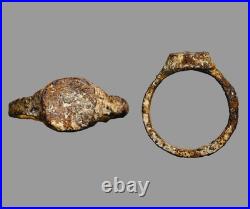


Crusader Period Iron Signet Ring, Jerusalem Find, Circa 12th-13th Century AD. Certified Authentic Ancient Artifact. Culture: Crusader (Latin Kingdom of Jerusalem). Type: Administrative Signet Ring. Size: US Ring Size 7. Provenance: Jerusalem find; Private collection; acquired by me in 2024. A rugged and historically evocative Crusader-period iron signet ring, recovered from the Jerusalem region. The ring features a circular, raised bezel and a sturdy hoop that expands toward the shoulders. While the high iron content has resulted in heavy archaeological oxidation, the profile is characteristic of the functional, everyday signets used by the Frankish settler population, merchant classes, or lower-tier military personnel in the Latin East. In the 12th and 13th centuries, iron was a common material for personal signets among those who required a durable tool for sealing wax on trade manifests and local correspondence. Despite the surface corrosion, the ring’s robust construction reflects the militarized and practical nature of life in the Crusader states. Authentication Notes (Ancient Surface and Tool Assessment). Iron Mineralization: The surface exhibits a dense, multi-layered “concretion” of iron oxides and compacted soil. This type of heavy, stable oxidation only occurs after centuries of anaerobic burial in the specific mineral conditions found in and around the Old City of Jerusalem. Forged Construction: The hoop and bezel show the slight irregularities of manual blacksmithing. Unlike modern cast iron, ancient wrought iron was hammered into shape, leading to the distinct “organic” profile seen in the side view. Morphological Wear: The interior of the hoop shows significant thinning at the base, a result of decades of continuous wear against the finger in antiquity before it was lost or buried. Bezel Geometry: The raised, circular platform is a classic high-medieval form, designed to press a deep, clear impression into hot beeswax or lead bullion seals. Cultural and Artistic Context. Following the First Crusade, Jerusalem became a hub of Western European administration in the heart of the Levant. While the elite wore gold and silver, the vast majority of the “Franks” (as the Crusader settlers were known) relied on iron for their functional jewelry. An iron signet was a mark of a “free man”-someone with the legal right to sign documents and engage in contract-based trade. Finding such a piece in Jerusalem connects it directly to the bustling administrative and military life of the Holy City during the Middle Ages. Tower of David Museum, Jerusalem (Medieval iron finds from the Citadel excavations). The Israel Museum, Jerusalem (Crusader-period functional metalwork and daily life artifacts). The British Museum, PE 1856,0701.2185 (Medieval iron finger rings). Jewelry in the Latin Kingdom of Jerusalem, Section: Iron and Base Metal Adornments. Jerusalem in the Time of the Crusades, p. 155-160 (On material culture and daily tools). The iron is heavily oxidized but remains structurally sound. The concretion is stable and provides a direct physical link to its long burial in the Jerusalem soil.