
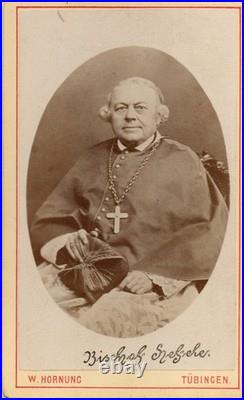

ANTIQUE Karl Josef von Hefele German Catholic bishop CDV PHOTO BY W. SIZE: 6.2 X 10.0 CM. Karl Josef von Hefele (March 15, 1809 – June 6, 1893) was a Roman Catholic bishop and theologian of Germany. Hefele was born at Unterkochen in Württemberg and was educated at Tübingen, where in 1839 he became professor-ordinary of Church history and patristics in the Roman Catholic faculty of theology, while collaborating along with William Robinson Clark to his major work. From 1842 to 1845 he sat in the National Assembly of Württemberg. In December 1869 he was enthroned bishop of Rottenburg. His literary activity, which had been considerable, was in no way diminished by his elevation to the episcopate. By John Dalton, 1860; and his still more celebrated Conciliengeschichte (History of the Councils of the Church), in seven volumes, which appeared between 1855 and 1874 Eng. Hefele’s theological opinions inclined towards the more liberal school in the Roman Catholic Church, but he nevertheless received considerable signs of favour from its authorities and was a member of the commission that made preparations for the Vatican Council of 1870. On the eve of that council, he published at Naples his Causa Honorii Papae, which aimed at demonstrating the moral and historical impossibility of papal infallibility. About the same time, he brought out a work in German on the same subject. He took rather a prominent part in the discussions at the council, associating himself with Félix Dupanloup and with Georges Darboy, archbishop of Paris, in his opposition to the doctrine of Infallibility, and supporting their arguments from his vast knowledge of ecclesiastical history. In the preliminary discussions he voted against the promulgation of the dogma. He was absent from the important sitting of June 18, 1870, and did not send in his submission to the decrees until 1871, when he explained in a pastoral letter that the dogma “referred only to doctrine given forth ex cathedra, and therein to the definitions proper only, but not to its proofs or explanations”. In 1872 he took part in the congress summoned by the Ultramontanes at Fulda, and by his judicious use of minimizing tactics he kept his diocese free from any participation in the Old Catholic schism. The last four volumes of the second edition of his History of the Councils have been described as skillfully adapted to the new situation created by the Vatican decrees. During the later years of his life, he undertook no further literary efforts on behalf of his church but retired into relative privacy. Within 24 hours the items won are sent to winners. And please keep in mind that I cannot influence any speed loss products reaching the destination. Please if you have any questions do not hesitate to contact me. Sometimes mistakes are made so. Please contact me if you have any problems and I’m sure we can work it out. Thank you for your time and interest in my auctions. Please watch my other auctions. I stand behind my goods, so you can shop at my store with confidence.