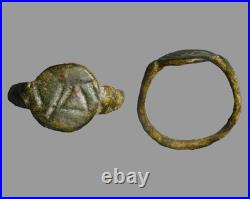


Ancient Near Eastern Phoenician Bronze Signet Ring Inscribed Paleo-Hebrew Letter Mem 500BC Size 7 Authentic. Authentic ancient artifact, guaranteed genuine and accompanied by a Certificate of Authenticity. Near Eastern / Levantine Find. Culture: Ancient Near Eastern (Phoenician / Levantine Horizon). Date: Circa 6th-5th Century BC c. Material: Bronze (Copper Alloy). Type: Personal Seal / Signet Ring. Size: Ring Size 7 Approx. 17.3 mm Inner Diameter / Bezel Diameter approx. This is an authentic, highly significant ancient Near Eastern bronze signet ring measuring a wearable US size 7, dating to the pivotal historic period around 500 BC. This era reflects the rich cultural and trade intersections across the ancient Levant and coastal Phoenicia. The ring features a prominent, flat circular bezel displaying a deeply incised, bold Northwest Semitic character rendered in the classic archaic Paleo-Hebrew / Phoenician script. The letter is a beautifully executed Mem (??), defined by its characteristic zig-zag or wavy horizontal head and sharp, downward diagonal stem. In the ancient Near East, the letter Mem translates conceptually to “water” (Mayim). On personal signet rings, a single bold letter of this type served a vital practical purpose as a personal monogram or official seal for a merchant, administrator, or local elite. It would be pressed directly into soft clay or wax seals (bullae) to finalize trade contracts, secure storage jars, or validate official correspondence. The construction is classic pre-Hellenistic Near Eastern smithing, featuring a robust, hand-forged hoop that integrates seamlessly into a thick, flat setting. The artifact is presented in an outstanding, completely uncleaned archaeological condition. The solid bronze module has developed a beautiful dark olive-green and chocolate-brown “river” patina, heavily highlighted by a stable, cream-colored calcareous soil matrix and light traces of reddish iron oxide deep within the engraved letter recesses. Inscription:?? (Archaic Semitic Letter Mem). Script Type: Phoenician / Paleo-Hebrew / Old Aramaic. Function: Personal or administrative monogram seal representing a prominent name beginning with the “M” phonetic sound (such as Mattan, Menahem, or Miqa), or denoting a specific administrative office or cargo standard. The signet ring demonstrates flawless diagnostic indicators of genuine antiquity. The incised Mem character displays the characteristic manual chisel stops and microcrystalline wear within the grooves, which are tightly packed with genuine ancient soil matrix compacted to stone-like hardness over twenty-five centuries. Under magnification, the hoop shows the slight asymmetry and hand-hammered texture of ancient manual construction rather than modern precision casting or industrial wire drawing. No modern seams, mechanical file marks, or artificial chemical washes are present. Comparable Examples & References. Inscribed personal signet rings from the 1st Millennium BC Levant are highly coveted documents of early epigraphy. Extensive collections of Northwest Semitic seals, rings, and stamped bullae can be studied in the permanent West Semitic Antiquities galleries at the Louvre Museum in Paris and the Israel Museum in Jerusalem. For deep typological classification of ancient Levantine signets, collectors can consult Nahman Avigad and Benjamin Sass’s definitive corpus Corpus of West Semitic Stamp Seals, as well as Joseph Naveh’s Early History of the Alphabet. Excellent archaeological condition, presenting an entirely stable and authentic as-found surface. The ring retains its full structural integrity, a perfectly round and exceptionally robust finger hoop, and maximum legibility of the engraved script. The thick, multi-layered mineral patina seals the core entirely, preserving this exquisite piece of ancient personal property so that it remains fully wearable today.